

For industrial buyers sourcing tomato-based ingredients for sauces, purées, ketchup, and other processed foods, understanding Hot Break tomato paste is essential. At Taichy Food, we produce premium Hot Break tomato paste with advanced processing lines designed to deliver high viscosity, excellent stability, and consistent quality.
1. What Is Hot Break Tomato Paste?
Hot Break tomato paste is a concentrated tomato product made by crushing fresh ripe tomatoes and immediately heating them to 85–95°C (185–203°F). This rapid high-temperature treatment inactivates pectin-degrading enzymes, preserving natural pectin and ensuring:
- High viscosity
- Thick, stable consistency
- Excellent heat stability during further processing
Definition: Hot Break tomato paste is produced through rapid enzyme inactivation at high temperatures, designed to maintain pectin and deliver a dense, stable texture suitable for industrial processing.
2. Hot Break vs Cold Break: Key Differences
The terms “Hot Break” (HB) and “Cold Break” (CB) refer to the temperature used immediately after crushing, which directly affects viscosity, color, and stability:
| Feature | Hot Break (HB) | Cold Break (CB) |
|---|---|---|
| Crushing Temperature | 85–95°C | 55–65°C |
| Pectin Retention | High | Moderate |
| Viscosity | High | Low to medium |
| Heat Stability | Excellent | Moderate |
| Color | Slightly darker | Brighter red |
| Typical Applications | Ketchup, high-viscosity sauces, industrial seasoning | Juice, purées, color-sensitive sauces, concentrated products |
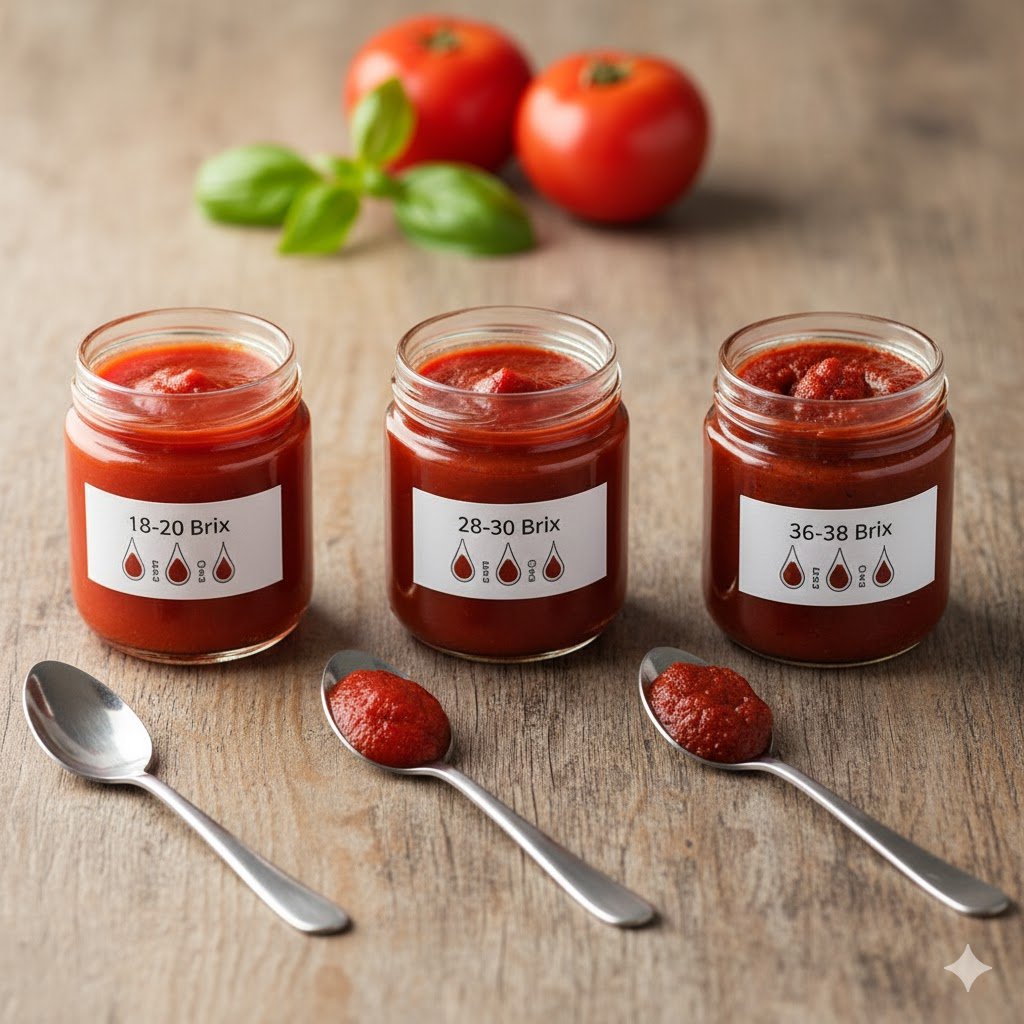
At Taichy Food, our Cold Break products are available in:
- 28–30 Brix CB: Suitable for purées, juice, and low-viscosity applications
- 36–38 Brix CB: Suitable for concentrated tomato products
Hot Break is preferred where high viscosity and thermal stability are critical.
3. How Hot Break Tomato Paste Processing Line Works
A Hot Break tomato paste line is a specialized system designed to crush tomatoes and immediately apply high heat to stabilize pectin. The typical process at Taichy Food includes:
- Receiving & Sorting
Fresh, ripe tomatoes are washed and inspected. - Hot Break Crushing
Tomatoes are crushed and heated to 85–95°C using a Hot Break crusher and tubular heater to rapidly deactivate pectin-degrading enzymes. - Refining
Skins, seeds, and fibers are removed through sieving units for smooth paste. - Evaporation (Concentration)
Pulp is concentrated to the desired Brix:- 28–30 Brix Hot Break
- Vacuum evaporators ensure controlled concentration.
- Sterilization
UHT or short-time high-temperature sterilization ensures long-term product stability. - Aseptic Filling
Packed into:- 220L aseptic steel drums
- 1000L IBC tanks
- OEM/private label options
4. Physicochemical Effects of Hot Break Processing
Hot Break processing not only affects viscosity and stability but also has subtle effects on key physicochemical indicators:
| Parameter | Hot Break Effect | Explanation |
|---|---|---|
| pH / Acididity | Minimal change | Heat is short-time; organic acids largely preserved |
| Brix | Slight increase possible | Minor water evaporation during Hot Break step |
| L* (Lightness) | Slight decrease | Color darkens due to heat treatment |
| a* (Redness) | Slight increase | Enhanced red color from lycopene release |
| b* (Yellowness) | Slight increase | Minor yellow pigment effect |
| Viscosity / Stability | Significantly higher | Pectin is preserved, preventing thinning or syneresis |
Conclusion: Hot Break improves viscosity, heat stability, and color depth, while acid content and soluble solids (Brix) remain largely unaffected.
5. Key Advantages and Limitations of Hot Break Tomato Paste
Advantages:
- High viscosity and stable structure
- Excellent heat stability for pasteurization and long cooking
- Rich, deep red color
- Resistance to syneresis
- Industrial versatility for ketchup, sauces, ready meals, and concentrated products
Limitations:
- Slightly darker color than Cold Break
- Flavor may be less fresh compared to Cold Break used in color-sensitive applications
6. Taichy Food Hot Break & Cold Break Products
| Product | Brix | Description | Packaging |
|---|---|---|---|
| Hot Break Tomato Paste | 28–30 | Medium-high viscosity, ideal for sauces, purées, and industrial processing | 220L drums, 1000L IBC, OEM/private label |
| Cold Break Tomato Paste | 28–30 | Low-viscosity, bright color, suitable for juice and purées | 220L drums, 1000L IBC |
| Cold Break Tomato Paste | 36–38 | High-concentration, suitable for concentrated tomato products | 220L drums, 1000L IBC |
Certifications: ISO 9001 | HACCP | BRC | Halal | Kosher
7. Applications of Hot Break Tomato Paste
- Ketchup manufacturing
- Tomato sauces and dressings
- Concentrated purées
- Ready meals and canned foods
- Industrial condiments and seasonings
- Foodservice and catering products
Its high viscosity and heat stability make Hot Break tomato paste the preferred choice for industrial processors worldwide.
8. Learn More: Hot Break vs Cold Break
Curious about the differences between Hot Break and Cold Break tomato paste and which is best for your application?
👉 Click here to explore the differences
9. Contact Taichy Food
Looking for a reliable supplier of 28–30 Brix Hot Break or Cold Break, or 36–38 Brix Cold Break? We provide:
- Free product consultation
- Technical specification sheets
- Customized viscosity and color
- OEM/private label production
🌐 Website: https://www.taichytomato.com
✉️ Email: info@taichysupply.com
📱 WhatsApp / Phone: +86-15022770702

 English
  Russian
  Arabic
  French
  Turkish
  Urdu
Urdu  Vietnamese
  Thai
Thai  Tagalog