

Cold Break Tomato Paste Overview
In the global tomato processing industry, selecting the correct processing method directly determines the final product’s viscosity, color, and flavor. Cold break tomato paste is widely preferred by manufacturers that prioritize bright red color, fresh tomato aroma, and high solubility.
This technical guide explains what is cold break tomato paste, its outcome and product characteristics, detailed specifications, processing line, equipment, pricing logic, and industrial applications. It is designed for food manufacturers, ingredient buyers, and quality managers.
What Is Cold Break Tomato Paste?
Cold break tomato paste is produced by heating freshly crushed tomatoes to approximately 65–75°C before enzymatic treatment and concentration.
Unlike the hot break process, this lower temperature only partially deactivates natural pectin-degrading enzymes. As a result, the pectin structure breaks down slightly, producing a paste with lower viscosity and higher flowability.
Why Is It Called “Cold Break”?
The term “cold” is relative. It refers to the lower pre-heating temperature compared with the hot break process, which typically exceeds 85–100°C.
Key Outcome:
- Brighter red color
- Fresher, vine-ripened tomato aroma
- More fluid consistency
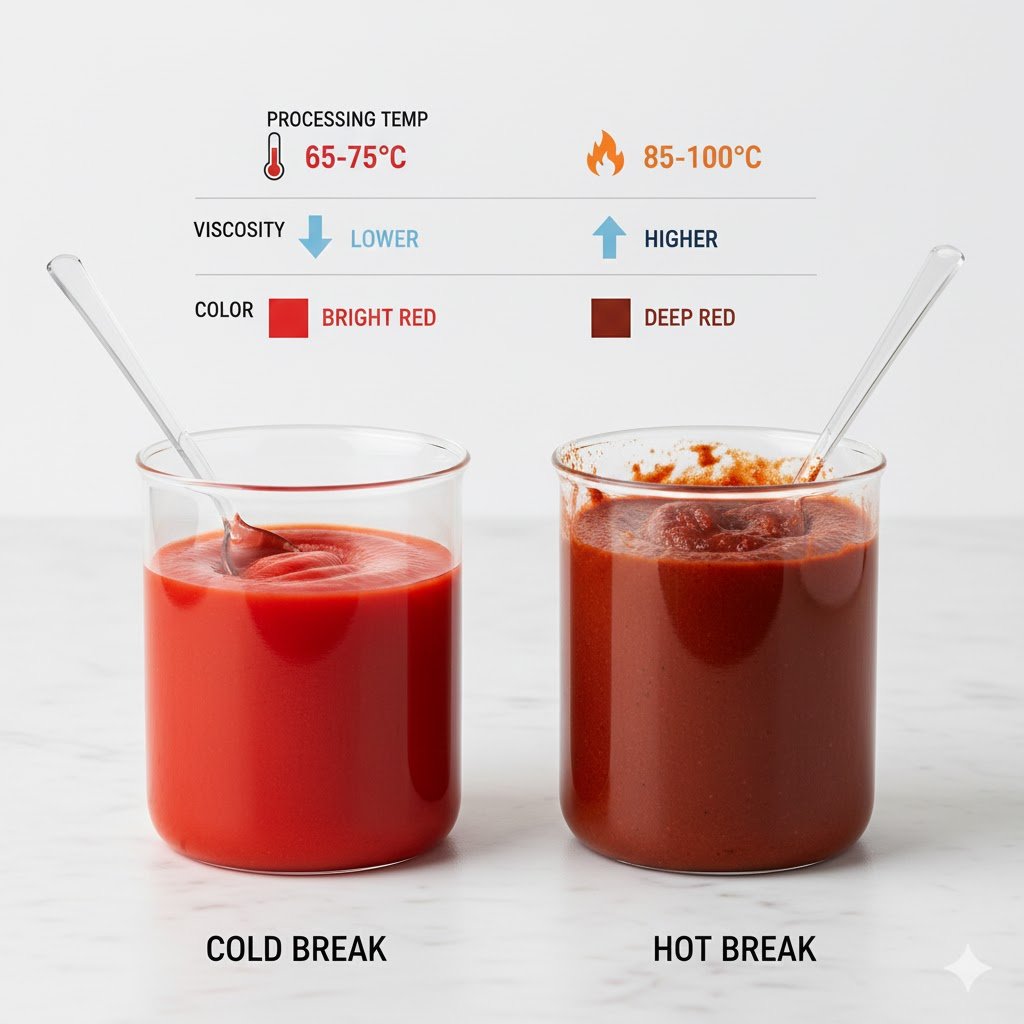
Outcome and Product Characteristics of Cold Break Tomato Paste
Understanding the outcome and product characteristics is critical when selecting tomato paste for downstream processing.
Key characteristics include:
- Lower viscosity (higher Bostwick value)
- Excellent solubility in water-based systems
- Vivid red color (higher a/b value)
- Fresh, tangy flavor profile without overcooked notes
These properties make tomato paste cold break especially suitable for products requiring smooth texture and easy dispersion.
Cold Break vs. Hot Break Tomato Paste: Technical Comparison
| Parameter | Cold Break (CB) | Hot Break (HB) |
|---|---|---|
| Heating Temperature | 65–75°C | 85–100°C |
| Viscosity | Lower | Higher |
| Bostwick (30 sec) | 6.0–10.0 cm | 3.5–5.5 cm |
| Color (a/b) | ≥ 2.10 (bright red) | 1.90–2.05 |
| Flavor | Fresh, light | Deep, cooked |
| Typical Applications | Ketchup, juice | Sauces, pizza toppings |
Cold Break Tomato Paste Specification
Accurate specifications ensure formulation consistency and stable production performance.
| Parameter | Cold Break Specification |
|---|---|
| Brix Options | 28–30%, 36–38% |
| pH | ≤ 4.5 |
| Bostwick | 6.0–10.0 cm / 30 sec |
| Color (a/b) | ≥ 2.10 |
| Additives | None (100% tomato) |
Taichy Food supplies both cold break tomato paste 28–30 Brix and cold break tomato paste 36–38 Brix, produced under strict international food safety and quality standards.
Cold Break Tomato Paste Process
The cold break tomato paste process is designed to preserve color and aroma while achieving the desired solids concentration.
Processing Steps
- Raw Material Selection & Washing – Fully ripe, high-solid tomatoes only
- Crushing & Low-Temperature Heating – Controlled at 65–75°C
- Refining – Removal of skins and seeds
- Vacuum Evaporation – Water removal under reduced pressure
- Aseptic Filling – Ensures extended shelf life
Concentrator Tomato Paste Cold Break System
A concentrator tomato paste cold break system is essential for producing high-Brix products without thermal damage.
Key advantages:
- Gentle evaporation at low temperature
- Stable color retention
- Efficient concentration to 36–38 Brix
This technology allows CB paste to maintain fresh flavor while meeting industrial concentration requirements.
Cold Break Tomato Paste Equipment Overview
Producing premium CB paste requires specialized cold break tomato paste equipment, including:
- Low-temperature tubular pre-heaters
- Enzymatic control systems
- High-efficiency vacuum evaporators
- Aseptic sterilizers and fillers
Each component is calibrated to protect color, aroma, and flowability.
Cold Break Tomato Paste Line Configuration
A complete cold break tomato paste line integrates raw material handling, thermal control, concentration, and aseptic packaging.
Typical output formats:
- 220L aseptic drums
- Tin cans (for further repacking)
The line is optimized for both export and OEM supply chains.
Cold Break Tomato Paste Price: Market Insights
The cold break tomato paste price varies based on several industrial factors:
- Brix level (36–38 Brix commands a premium)
- Crop year & tomato quality
- Energy and processing efficiency
- Packaging format (220L aseptic drum)
Cold break tomato paste price varies significantly depending on Brix level, packaging, and seasonal raw material availability.
For accurate, real-time pricing, direct supplier quotation is recommended.
Applications of Tomato Paste Cold Break
Due to its functional properties, tomato paste cold break is widely used in:
- Ketchup production – Bright color and pourable texture
- Tomato juice & soups – High solubility
- Condiments – Smooth, non-gelled consistency
Why Choose Taichy Food?
As a professional tomato paste manufacturer and exporter, Taichy Food offers:
- Stable cold break tomato paste specifications
- OEM and customized packaging solutions
- Reliable bulk supply for industrial clients
- Technical documentation and specification sheets
Request a Sample or Quotation
Contact our sales team to:
- Receive cold break tomato paste specifications
- Request samples
- Obtain a competitive price quotation

 English
  Russian
  Arabic
  French
  Turkish
  Urdu
Urdu  Vietnamese
  Thai
Thai  Tagalog