
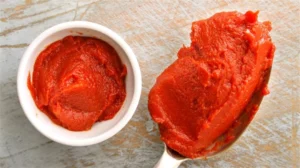
Viscosity measures a fluid’s resistance to flow, and for tomato paste/sauce, it determines the product’s texture, mouthfeel, and processability in production and application.
1. Main Factors Influencing Viscosity (What affects it)
The viscosity of tomato concentrate and sauce is primarily affected by two main factors and two key processes:
A. Core Factor: Solid Content (Brix)
- Impact: A higher Brix value means more dissolved solids (mainly sugars, pectin, and tomato fibers), which increases internal friction within the liquid, naturally leading to higher viscosity.
- Relationship: Viscosity is positively correlated with Brix.
B. Core Factor: Tomato Pectin
- Impact: Pectin is a polysaccharide naturally found in the cell walls of tomatoes. It forms a network structure in the solution and is the primary substance responsible for giving tomato sauce its viscosity.
- Role of Hot/Cold Break: The heat treatment process is designed to control the activity of the Pectinase enzymes that break down pectin.
C. Core Process: Heat Treatment Method
| Processing Method | Impact on Viscosity |
| Hot Break | High Viscosity: High temperature rapidly deactivates Pectinase enzymes, preserving the pectin structure. |
| Cold Break | Low Viscosity: Lower temperature allows Pectinase enzymes to remain active, breaking down some pectin and reducing viscosity. |
D. Secondary Factor: Tomato Variety
Different tomato varieties have different natural levels of pectin and fiber, which affects the potential maximum viscosity of the final product.
2. Main Range and Measurement (How is it measured and expressed)
The viscosity of tomato sauce is generally not expressed in absolute units like Pascal-seconds but is measured and expressed using the industry-standard “consistency” via the Bostwick Consistometer.
| Metric | Unit of Measurement | Definition | Typical Range (for a 30∘Bx Product) |
| Bostwick | Centimeters (cm) / 30 sec | Measures the distance the sauce flows in a standard 30 seconds. | 4 cm – 12 cm(Lower the number, Higher the viscosity). |
- High Viscosity: Low Bostwick number (e.g., 4.0 cm), sauce barely flows.
- Low Viscosity: High Bostwick number (e.g., 10.0 cm), sauce flows quickly.
3. Primary Role of Viscosity (Why is it important)
Viscosity is critical for the product’s functionality and sensory attributes:
- Mouthfeel and Texture: Viscosity directly determines the product’s “thickness” or “body.” High viscosity gives the impression of being “rich” and “high-concentration.”
- Preventing Syneresis: Especially important in Frozen Foods, high viscosity “locks in” moisture, preventing the product from becoming watery upon thawing or reheating, maintaining structural stability.
- Applicability/Processability:
- Coating Stability: High viscosity (low Bostwick) pizza sauce remains stable on the crust and does not soak in or run off during baking.
- Pourability: Ketchup must have moderate viscosity (mid-range Bostwick) to be pourable, but not too runny (too fast) or too thick (cannot be poured).
- Cost Impact: High-viscosity concentrates (Hot Break) are typically more expensive due to their enhanced functional properties.
4. Viscosity Selection (How to make a choice)
Clients should choose the appropriate viscosity based on the final product application scenario:
| Client Product Application | Viscosity Requirement | Recommended Heat Treatment | Recommended Bostwick Range (Example) |
| Frozen Food / Pizza Sauce | Extremely High Viscosity | Hot Break | Below 6.0 cm |
| Bottled Ketchup | Medium Viscosity | Cold Break or Modified Hot Break | 8.0 cm – 12.0 cm |
| Canned Tomato Soup | Low Viscosity | Cold Break | 12.0cm or higher |
| Premium Sauce / Dip | High Viscosity | Hot Break | Below 8.0 cm |
5. Viscosity Measurement Method (How is it measured)
As mentioned, the tomato industry primarily uses the Bostwick Consistometer for measurement:
- Temperature Control: Adjust the tomato sauce or concentrate sample to the standard measurement temperature (usually 20° or 25°).
- Sample Loading: Load the sample into the starting reservoir of the Bostwick trough.
- Gate Release: Start the timer and simultaneously release the gate, allowing the sauce to flow.
- Read Distance: After $30$ seconds, measure the distance (in centimeters) the sauce has traveled.
- Recording: This distance is the Bostwick consistency value.
Click here to see the video
Note: For tomato concentrates, it is often necessary to dilute the sample to a standard Brix value (e.g., 12 Brix ) before measuring the Bostwick value. This eliminates Brix variability as a factor, allowing for a fair comparison of “viscosity quality.”

 English
  Russian
  Arabic
  French
  Turkish
  Urdu
Urdu  Vietnamese
  Thai
Thai  Tagalog