
This summary is intended for clients who need a systematic understanding of the key quality metrics for tomato concentrates and sauces, detailing the meaning of each value and its impact on product selection (such as Paste, Sauce, Ketchup, Soup, Frozen Food, etc.).
一、Key Metric: Brix (Soluble Solids)
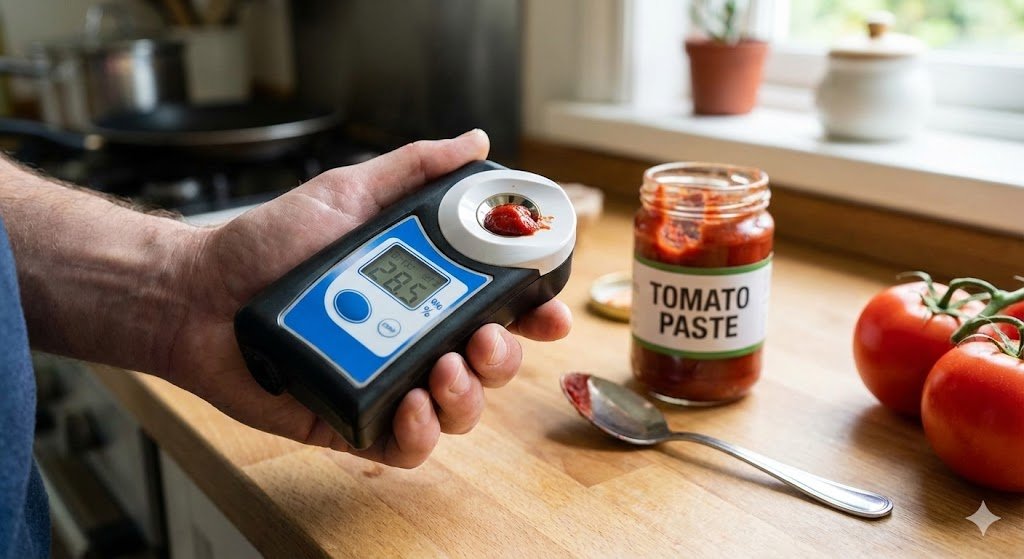
1. What is Brix?
| Metric:Represents the number of grams of dissolved solids per 100 grams of solution. | Definition | Measurement Method |
| Brix | Tomato products comprise natural tomato sugars, acids, and minerals, along with added sugar and salt. | Measured using a refractometer, based on the solution’s refractive index. |
| Actual Composition | Primarily reflects the product’s concentration level and sweetness. Higher Brix means lower water content and higher concentration. | |
| Significance | Primarily reflects the product’s concentration level and sweetness. Higher Brix means lower water content and higher concentration. |
2. Key Differences in Brix Grades, Visual Characteristics, and End Uses
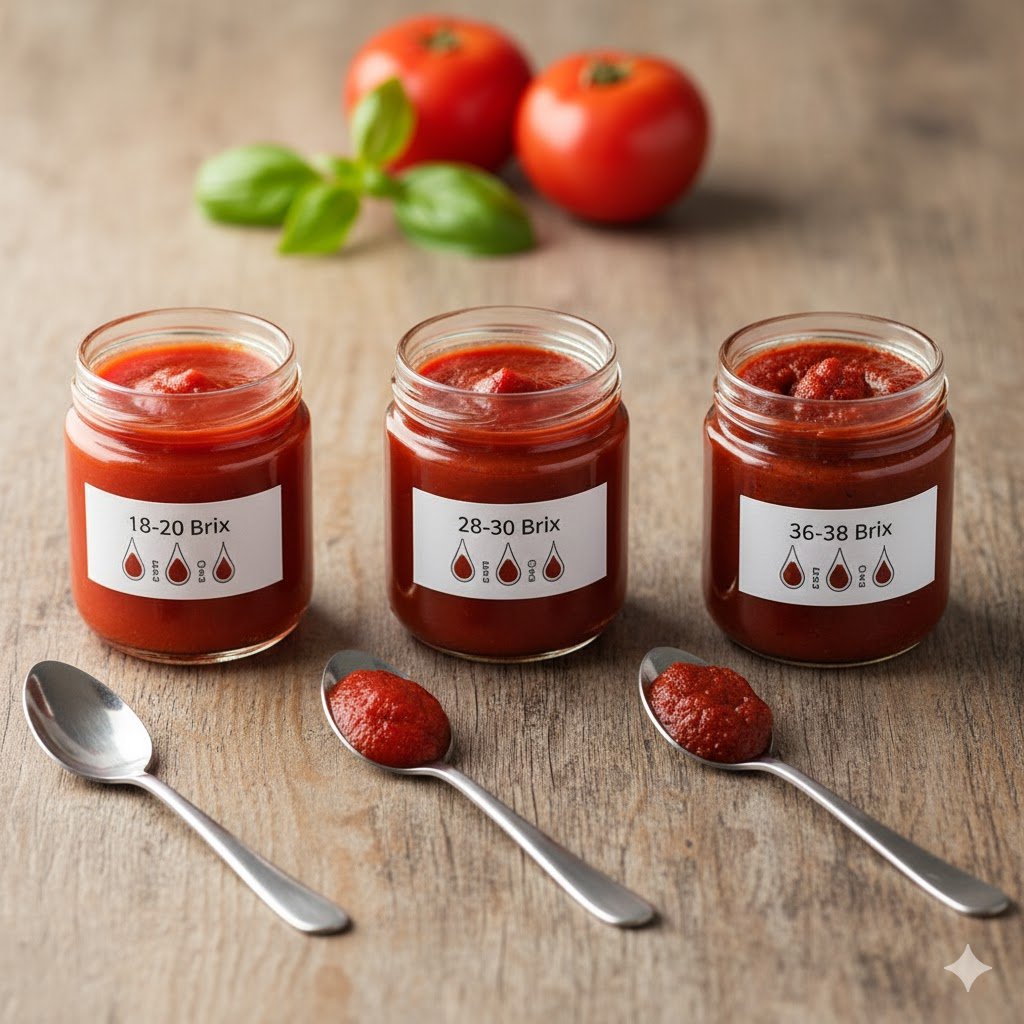
We mainly distinguish grades of tomato paste and tomato concentrate used as raw materials.
| Brix Range | Terminology | Appearance Assessment (Viscosity) | Primary Uses (Relevant to Client Products) |
| 28%-30% | Extra Grade Double Concentrated | Medium Viscosity. Pours slowly but steadily. Easily pumped and transported. | Base for final Ketchup, most Soups, Dipping Sauce, Salsas (formulas requiring higher flow). Most versatile. |
| 30%-32% | Triple Concentrated | Slightly higher viscosity, good flow. | Higher quality Ketchup, thicker Salsas, base material for pasta Sauces. |
| 36%-38% | Applications include pizza sauces (must remain stable at high temperatures), frozen foods (strict moisture limits), and high-viscosity paste bases. | Extremely High Viscosity. Paste-like, very difficult to pour, requires scooping, holds its shape when poured. | Extremely high viscosity. It has a paste-like consistency that is very difficult to pour; it requires scooping with a spoon and maintains its shape after being dispensed. |
II. Viscosity Metric: Bostwick Consistometer
1. Introduction to the Bostwick Consistometer
- The Bostwick Consistometer is a standardized instrument used to measure the viscosity or consistency of semi-fluid materials.
- Measurement Method: Measures the distance (in centimeters) that a sample of the product flows down a graded trough in $30$ seconds.
- Numerical Significance: The shorter the distance flowed, the higher the consistency (higher viscosity).
| Metric | Definition | Function |
| Bostwick | Directly reflects the product’s flowability over a set time. | Ensures product manageability during filling and pumping, and guarantees consistent texture and appearance for the final retail product. |
2. Viscosity and Heat Treatment: Hot/Cold Break
Viscosity is not only determined by Brix but also by the heat treatment method applied to the raw tomatoes:
| Processing Method | Effect | Viscosity | Applicable Products |
| Hot Break | Rapid heating above 90°. This process deactivates Pectinase enzymes. | High Viscosity (HMC- High Mold Count) | Pizza Sauce, Frozen Food, high-viscosity Paste, etc. |
| Cold Break | Heating at a lower temperature 65°-75°). Pectinase enzymes are not fully deactivated and continue to break down pectin. | Low Viscosity ({LMC – Low Mold Count) | Ketchup, Soups, Drinks (for dilution), Dipping Sauce, etc. |
If you want to know more about the Cold break VS Hot break , Click here .
III. Net Solids and Other Chemical Metrics
1. NTSS (Net Total Soluble Solids)
| Metric | Definition | Significance and Role | Change from Standard Brix (TSS) to NTSS |
| NTSS | Measures the solids content derived exclusively from tomatoes. It is calculated by subtracting non-tomato solids (such as added salt) from the TSS (Total Soluble Solids). | NTSS is always slightly lower than the Brix value. For example, a 30°Bx product with 1.0% added salt will have an NTSS of approximately 30 – 1.1 =28.9Bx (based on conversion factors). | NTSS is always slightly lower than the Brix value. For example, a 30°Bx product with 1.0% added salt will have an NTSS of approximately 30 – 1.1 =28.9Bx (based on conversion factors). |
| Role | Net Total Soluble Solids |
2. Other Key Chemical Metrics
| Metric | Definition | Role and Significance | Impact on Product Selection |
| Total Acidity | Total acidity (usually expressed as a percentage of Citric Acid). | Affects the product’s flavor balance and microbial safety (pH) | High acidity (low pH ) is more shelf-stable and has a “tangier” flavor; low acidity is “milder.” |
| Lycopenemg/100g | Lycopene content (mg/100g) | A key indicator of nutritional value, reflecting the tomato variety, maturity, and concentration. | High Lycopene content generally suggests a healthier raw material and a deeper red color. |
3. Color Metrics: L, A/B
| Metric | Definition | Role and Significance |
| L | Lightness: Ranges from 0 (pure black) to 100 (pure white). | A lower L value indicates a darker tomato color. |
| A/B | Redness Ratio: The ratio of the a value (red-green axis) to the b value (yellow-blue axis). | A higher A/B ratio means the product is redder (less yellow or brown). This is the most important metric for tomato color and quality. |
| Role | Ensures color consistency and visual appeal, and is crucial for distinguishing high-quality raw materials. |
Summary and Next Steps
| Client Target Product | Recommended Brix/Concentrate Type | Recommended Viscosity/Heat Treatment | Key Focus Metrics |
| Ketchup | 28-30 | Cold Break (Easy pumping and filling) | Bostwick (Must achieve good pouring speed), Total Acidity (Affects taste). |
| Pizza Sauce | 36-38 | ||
| Frozen Food | 36-38 | ||
| General Soup/Dip | 28-30 | Cold Break or Standard Viscosity | Total Acidity (Affects shelf life). |
How Storage Conditions Affect Brix in Drum Tomato Paste
Under normal conditions, outdoor storage does not reduce the Brix level of drum-packed tomato paste, provided the packaging remains fully sealed and intact. Brix is determined by the concentration of soluble solids, and without external water entering the drum, dilution does not occur.
In theory, prolonged exposure to warm outdoor conditions may cause minimal moisture evaporation, which could lead to a slight increase in Brix rather than a decrease. However, in properly sealed aseptic drums, this effect is usually negligible and often falls within normal analytical tolerance.
The primary risk to Brix stability during outdoor storage is water ingress caused by rain, condensation, or damaged packaging. As long as the drum is well protected, covered, and stored in dry conditions, the Brix level of tomato paste is expected to remain stable throughout its shelf life.
Observed Brix variations are more commonly related to sampling conditions and temperature correction during analysis rather than actual changes in product composition.
Storage conditions affect Brix only through moisture exchange, not through time or location itself.

 English
  Russian
  Arabic
  French
  Turkish
  Urdu
Urdu  Vietnamese
  Thai
Thai  Tagalog